When we talk about transformation, whether personal, professional, or relational, most people focus on tools, programs, or content. They buy books, watch videos, or join online courses, assuming that having access to a system or method is enough to create change. Yet, the reality is stark: systems only produce results when they are actively used.
This is especially true in coaching and mentoring, where engagement is the bridge between design and outcome.
Understanding Systems, Structures, and Processes
Before diving into why engagement matters, it’s essential to clarify the difference between three core components of any organised approach:
- Structures
- Definition: The physical or organizational elements that form the foundation of a system.
- In Coaching: In a WhatsApp coaching group, structures include the group itself, rules for participation, scheduled check-ins, and assigned roles.
- Key Point: Structures exist even if no one is actively using them—they are the “skeleton” of the system.
- Processes
- Definition: The sequences of actions or steps designed to achieve specific outcomes within a system.
- In Coaching: Processes in your WhatsApp group may include daily reflection prompts, weekly goal reports, accountability responses, and peer feedback.
- Key Point: Processes are instructions for action—they require consistent participation to function.
- Systems
- Definition: A combination of interconnected structures and processes that work together to deliver results.
- In Coaching: The WhatsApp coaching system only works if members engage with both the structure (group) and the processes (check-ins, responses, reflections).
- Key Point: A system is dynamic—it produces results only when it is actively used and maintained.
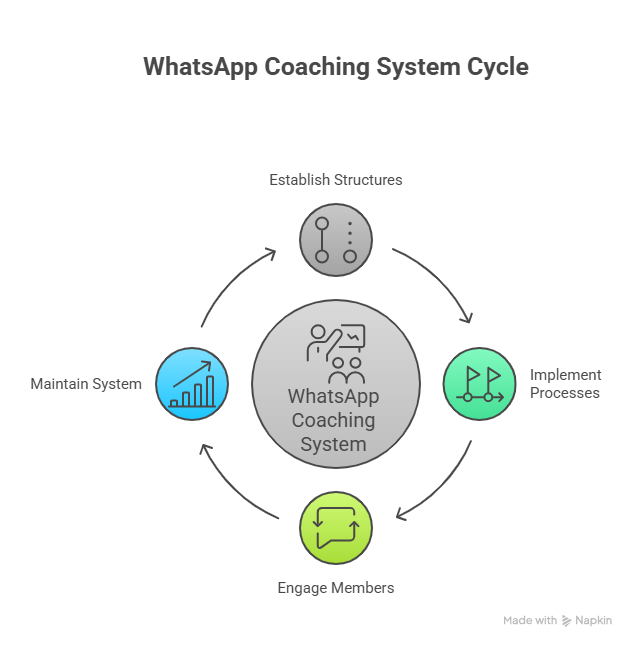
The Gap Between Design and Results
Many coaching programs fail—not because the system is flawed—but because participants do not use it consistently. You can design the perfect WhatsApp group with prompts, reminders, and pathways for feedback, but if members do not participate, the system remains dormant.
A system without engagement is like a gym full of equipment that no one uses. The structures exist, the processes are laid out, but no transformation occurs.
The Role of Leadership and Facilitation
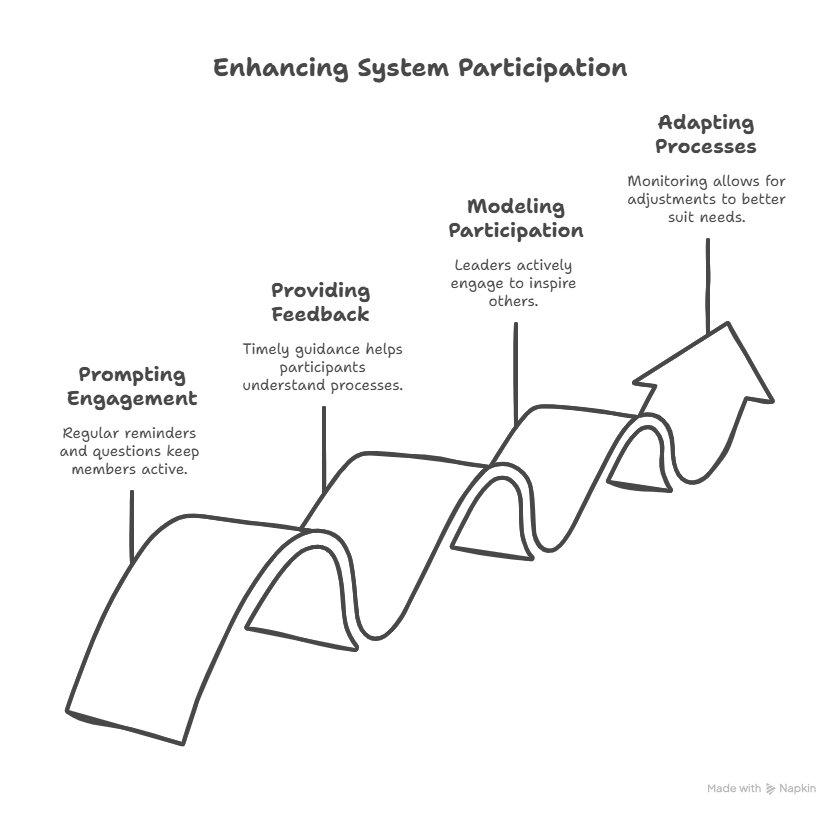
In coaching systems, the leader is not just a content provider—they are a facilitator, guide, and motivator. Here’s why your role matters:
- Prompting Engagement
- Regular reminders, thought-provoking questions, and encouragement keep members active in the system.
- Providing Feedback
- Timely guidance ensures that participants understand how to navigate the processes and apply them effectively.
- Modeling Participation
- Leaders who actively engage in the system demonstrate its value, inspiring members to follow suit.
- Adapting Processes
- Monitoring participation allows you to tweak prompts, reflection exercises, or reporting structures to better suit the group’s needs.
Without leadership, even the most well-designed system can stagnate. Engagement is the lifeblood of results.
WhatsApp Coaching as a Case Study
Consider your WhatsApp coaching group:
- Structures: The group itself, rules, and check-in schedules.
- Processes: Daily or weekly prompts, reflection exercises, and progress reporting.
- System: When members actively participate—responding to prompts, reflecting, and sharing insights—the system produces measurable results.
If members do not engage:
- The structure exists, but it’s inactive.
- The processes exist, but they are unexecuted.
- The system does not produce results.
This is why coaching programs must prioritise engagement strategies as much as content or design.
Engagement is the Key to Transformation
To maximise results:
- Clarify expectations: Members must understand that transformation requires active participation.
- Facilitate consistently: Regular interaction from the coach keeps the system alive.
- Provide accountability: Encourage members to report and reflect regularly.
- Reinforce value: Show participants the tangible benefits of engagement.
In short, a system is only as powerful as the engagement it receives. Structures and processes are essential, but without participation, they remain inert.
Conclusion
Coaching and mentoring systems are designed to deliver transformation. But no design, prompt, or structure can replace active participation. As a coach, your role is to facilitate, prompt, and guide members through the system, ensuring they are engaged and taking action.
The takeaway is clear: design your systems thoughtfully, but remember that results are created in real-time through action, not merely through planning or structure.
